Five-Stage Model for IMBH-TDE EP240222a
TBD!!! AI Version Website. This project focuses on the detailed theoretical modeling of EP240222a, a key candidate for a Tidal Disruption Event (TDE) involving an Intermediate-Mass Black Hole (IMBH). The unique, long-duration light curve of this event challenges standard TDE theory, necessitating a novel analytical framework.
The Challenge of EP240222a
Unlike typical TDEs characterized by fast, steep light curve decays, EP240222a exhibits peculiar features: a slower rise and a prolonged plateau phase. Our primary goal was to construct a physical model that self-consistently explains the multi-wavelength observations.
IMBH-TDE: Five-Stage Model
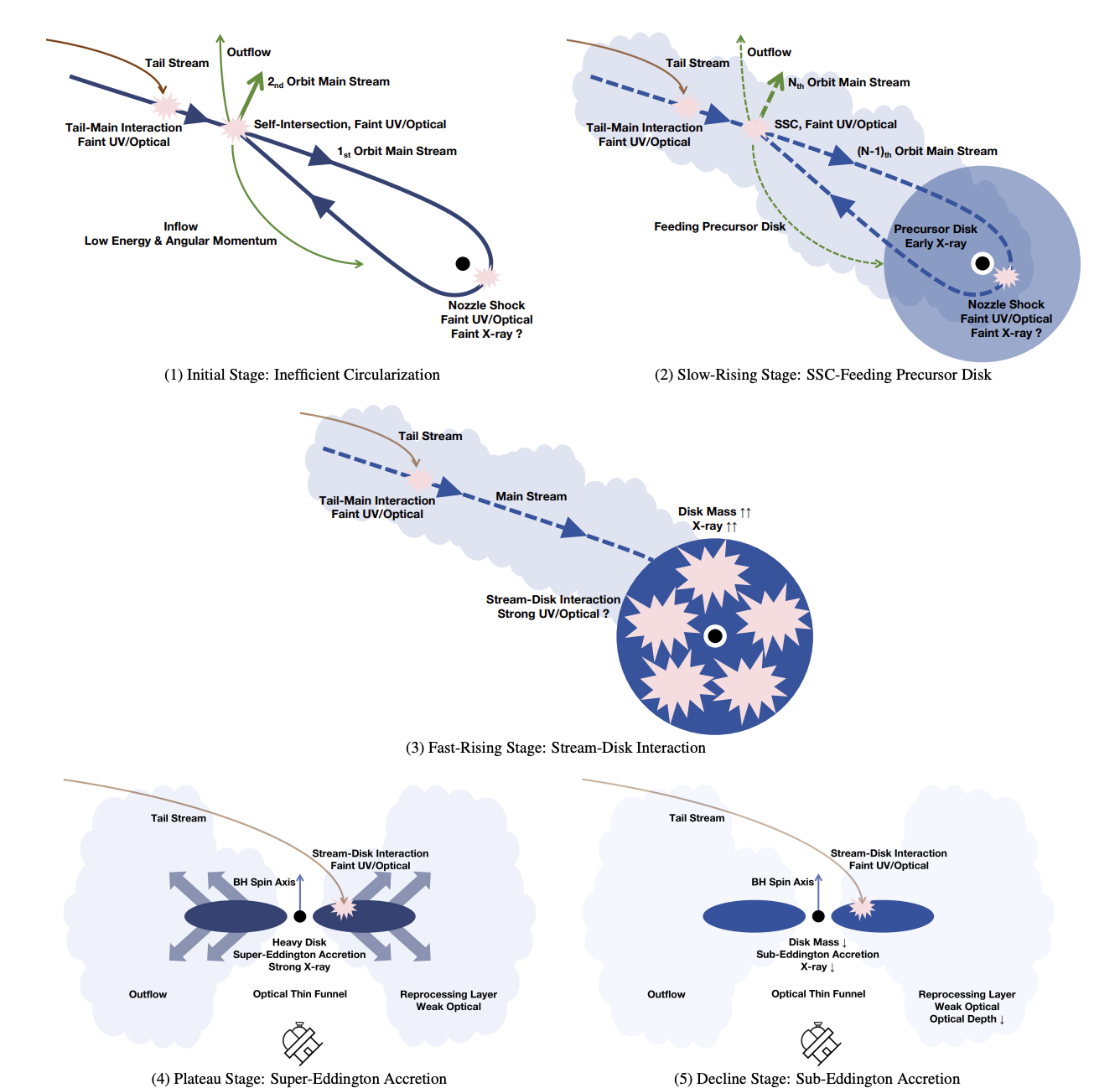
We developed a robust five-stage evolutionary model that links the debris stream dynamics to the observed luminosity:
The model stages include:
- Stage I: Disruption & Stream Fallback. Initial tidal stripping and free-fall of the stellar material back towards the black hole.
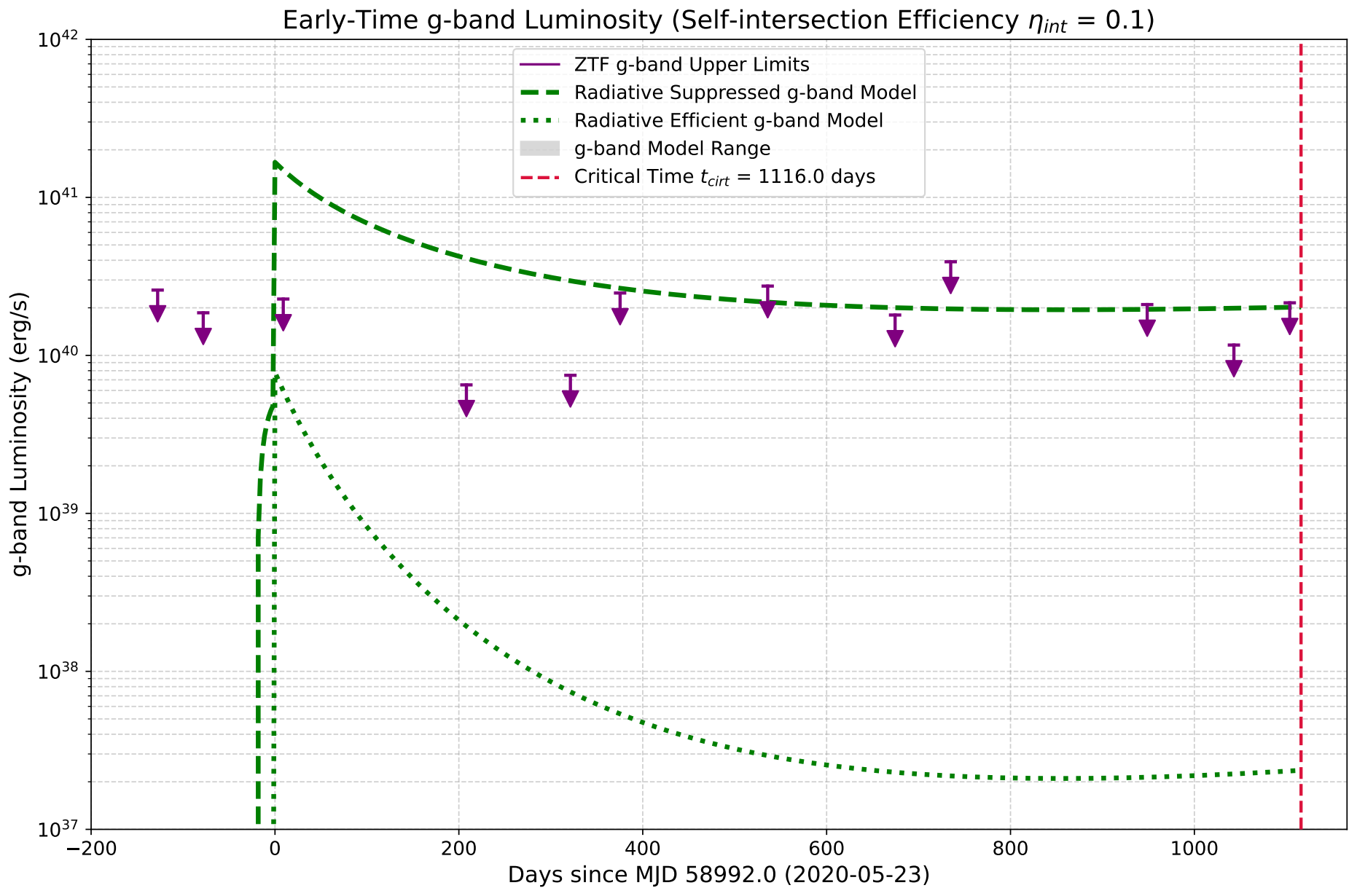
- Stage II: Delayed Stream-Stream Collision (Key). The unique timing where the leading and trailing edges of the stream collide, thermalizing the energy. This collision powers the initial optical/UV emission.
- Stage III: Inefficient Circularization. The stream material forms a highly eccentric orbit rather than immediately forming a stable disk, leading to the prolonged plateau phase observed in EP240222a.
- Stage IV: Accretion Disk Formation. Gradual circularization and formation of a standard accretion disk.
- Stage V: Luminosity Decay. The mass fallback rate drops below the critical Eddington rate, leading to the decay phase observed in the final stages.
Constraining IMBH Properties
This analytical work allowed us to place tight constraints on the IMBH mass, spin, and the star’s properties, providing crucial insights into the elusive IMBH population.

Related Publication
This project is fully detailed in the following work:
(Please note: Click on the ‘Submitted’ badge to view links to the accompanying video and slides from conference presentations.)