USTC-AstrXiv (蜗壳天文科研周报)
USTC-AstrXiv (nicknamed "WoKe Astro Weekly") is an automated email newsletter that identifies, formats, and distributes new astronomy-related papers from the University of Science and Technology of China (USTC) on arXiv. The system runs autonomously on a server and delivers a neatly formatted HTML email to subscribers every Monday morning.
TBD AI Ver!!! USTC-AstrXiv, also known as WoKe Astronomy Weekly, is an automated weekly digest that highlights new astronomy papers from the University of Science and Technology of China (USTC) posted on arXiv.
The project was inspired by StewarXiv, a similar service run by the Steward Observatory at the University of Arizona.
It was built with the assistance of modern AI tools such as Gemini and ChatGPT, especially for parts involving HTML and interface design—areas in which the author had little prior experience.
Logo and Name
The logo is both playful and symbolic:
- It resembles a snail shell, a nod to “WoKe” (蜗壳) — a homophone of “WoKe” meaning our university in Chinese slang.
- It also represents a spiral galaxy, evoking the astronomical theme.
The name LiWenXiv originated as a light-hearted pun by a senior student.
The goal of the project is to make it easier for USTC astronomers to keep track of their colleagues’ most recent work.

System Overview
The program is hosted on a remote server and runs automatically every week, identifying relevant arXiv papers and distributing the newsletter on Monday mornings.
Its architecture is clean and lightweight, consisting of four Python modules:
- (1) Author & Affiliation Recognition
- (2) Email Generation and Delivery
- (3) Subscription Management
- (4) Configuration and Parameters

(1) Author and Affiliation Recognition
The program runs every Sunday night, retrieving new submissions from several arXiv categories closely related to astronomy — including astro-ph, gr-qc, hep-ph, hep-th, nucl-th, and physics.
Roughly 1000 papers are processed each week.
While the arXiv API provides metadata, it often cannot reliably identify author affiliations.
To improve accuracy, the program downloads each paper’s TeX source, parsing it to detect whether at least one author is affiliated with USTC.
USTC papers are identified if their author list includes phrases such as:
- “Department of Astronomy, University of Science and Technology of China”
- “School of Astronomy and Space Science, University of Science and Technology of China”
Keywords are also extracted from the TeX source.
A short delay is inserted between downloads to prevent temporary blocking by the arXiv server.
(2) Email Generation and Delivery
Once USTC papers are identified, the program automatically generates a stylized HTML email summarizing them.
Highlights:
- HTML design and layout were created with the help of AI assistants (Gemini and ChatGPT).
- The logo is pixel-encoded rather than embedded as an image file, ensuring it is displayed even in restrictive email clients.
- Abstracts are left in uncompiled LaTeX form, as pre-rendered equations often display poorly or get blocked by email filters.
- The sender uses the author’s USTC email, but the “display name” is set to USTC-AstrXiv, providing a professional appearance.
A test email is sent to the author each Sunday.
If no issues are found, the weekly newsletter is automatically delivered to all subscribers early Monday morning.
(3) Subscription and Unsubscription
Subscribers can join or leave the mailing list simply by sending an email:
- To subscribe: send an email with the subject “Subscribe” or “订阅” to
liwenkai@mail.ustc.edu.cn - To unsubscribe: send an email with the subject “Unsubscribe” or “退订`”
The program uses keyword-based subject detection, so the keywords can appear anywhere in the subject line.
This lightweight approach is convenient for users, though in rare cases it might incorrectly add unrelated senders.
(4) Configuration and Parameters
All runtime parameters — such as API access range, file paths, and email templates — are defined in a dedicated configuration file for easy modification and maintenance.
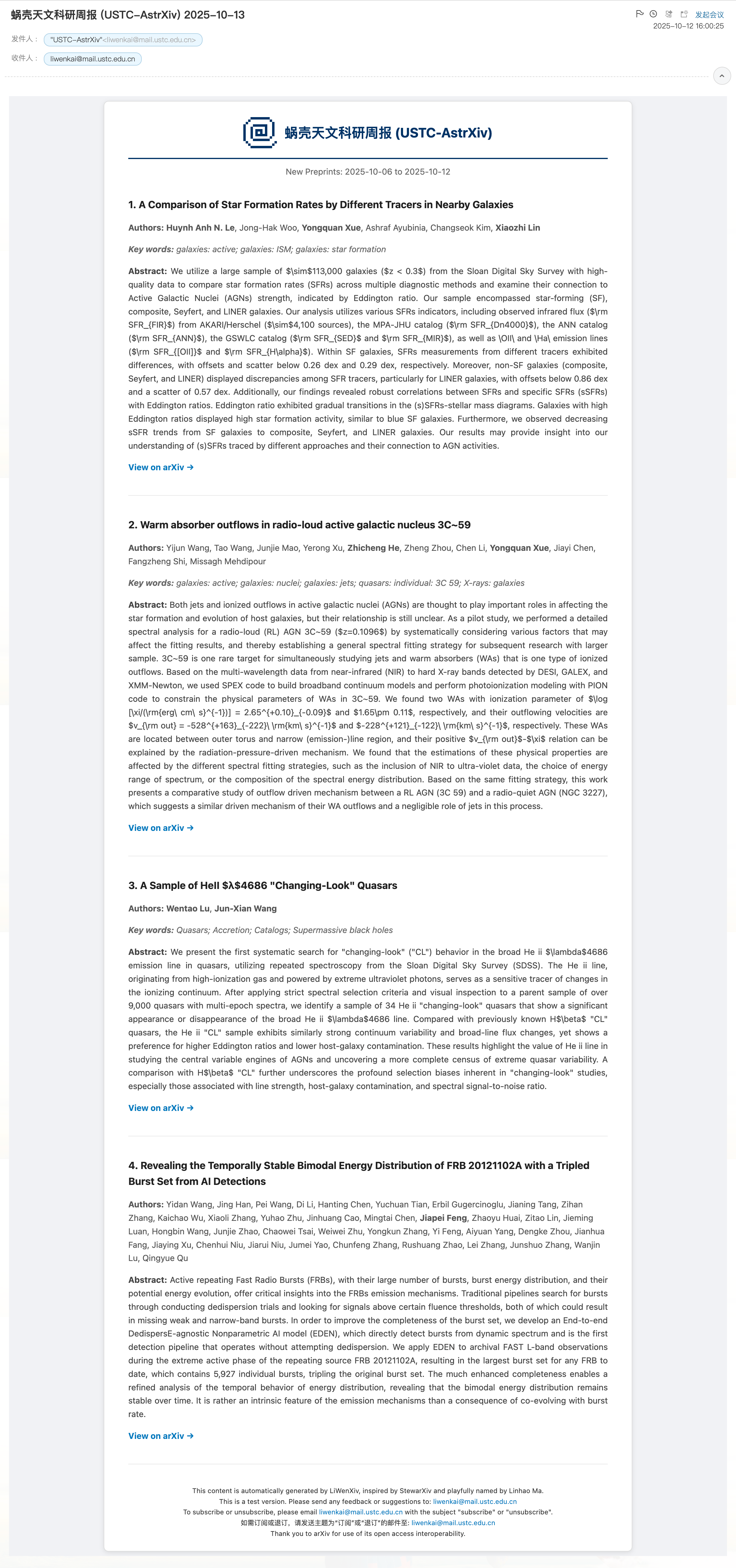
Example Output
Below is an example of the final newsletter as seen by subscribers.
It contains the pixel-encoded logo, paper titles, authors, abstracts, and arXiv links.
Acknowledgment
The development of USTC-AstrXiv was made possible through the open arXiv API and benefited greatly from the assistance of AI tools (Gemini and ChatGPT) in code generation and HTML rendering.